


 COREA:
Coupled
Relightable 3D Gaussians
COREA:
Coupled
Relightable 3D Gaussians TL;DR : COREA is the first unified three-tasks framework that couples an SDF and relightable 3D Gaussians to jointly support SH-based NVS, surface reconstruction, and inverse PBR.
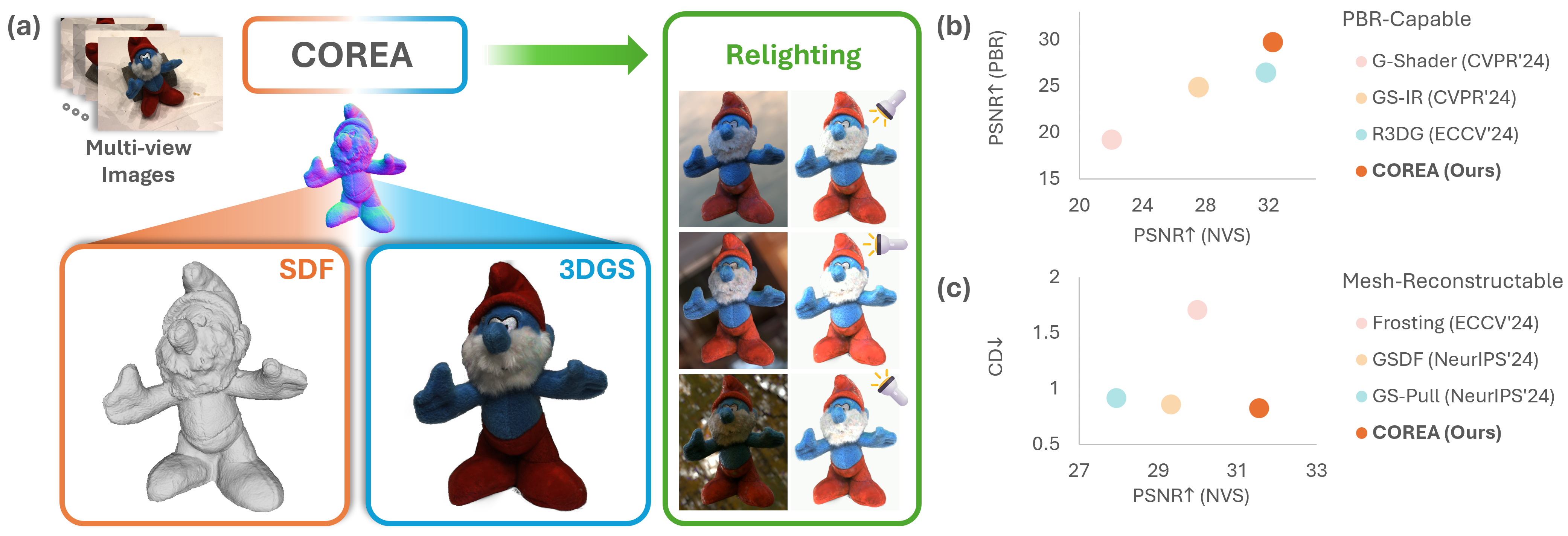
We present the first unified three-tasks framework that couples an SDF and relightable 3D Gaussians (3DGS) to jointly support SH-based novel-view synthesis (NVS), surface reconstruction, and inverse physically-based rendering (inverse PBR). While recent relightable 3DGS methods have progressed, inverse PBR remains bottlenecked by normal estimation, as the discrete nature of 3DGS often yields oversmoothed and unstable normals.
To address this limitation, COREA couples the complementary geometric properties of an SDF and relightable 3DGS on a shared underlying surface, where geometry-constrained relightable 3DGS provides reliable depth signals to anchor SDF geometry and the continuous SDF normal field provides spatially consistent supervision for Gaussian normal learning. We couple these signals through depth-guided alignment and normal supervision with normal-aware densification, and introduce Dual-Density Control to regulate densification by balancing photometric and geometric gradients for stable, memory-efficient training.
Experiments on standard benchmarks show that COREA is the only framework that supports all three tasks, achieving competitive performance overall, with particularly superior results in inverse PBR. The code and project page will be publicly released.
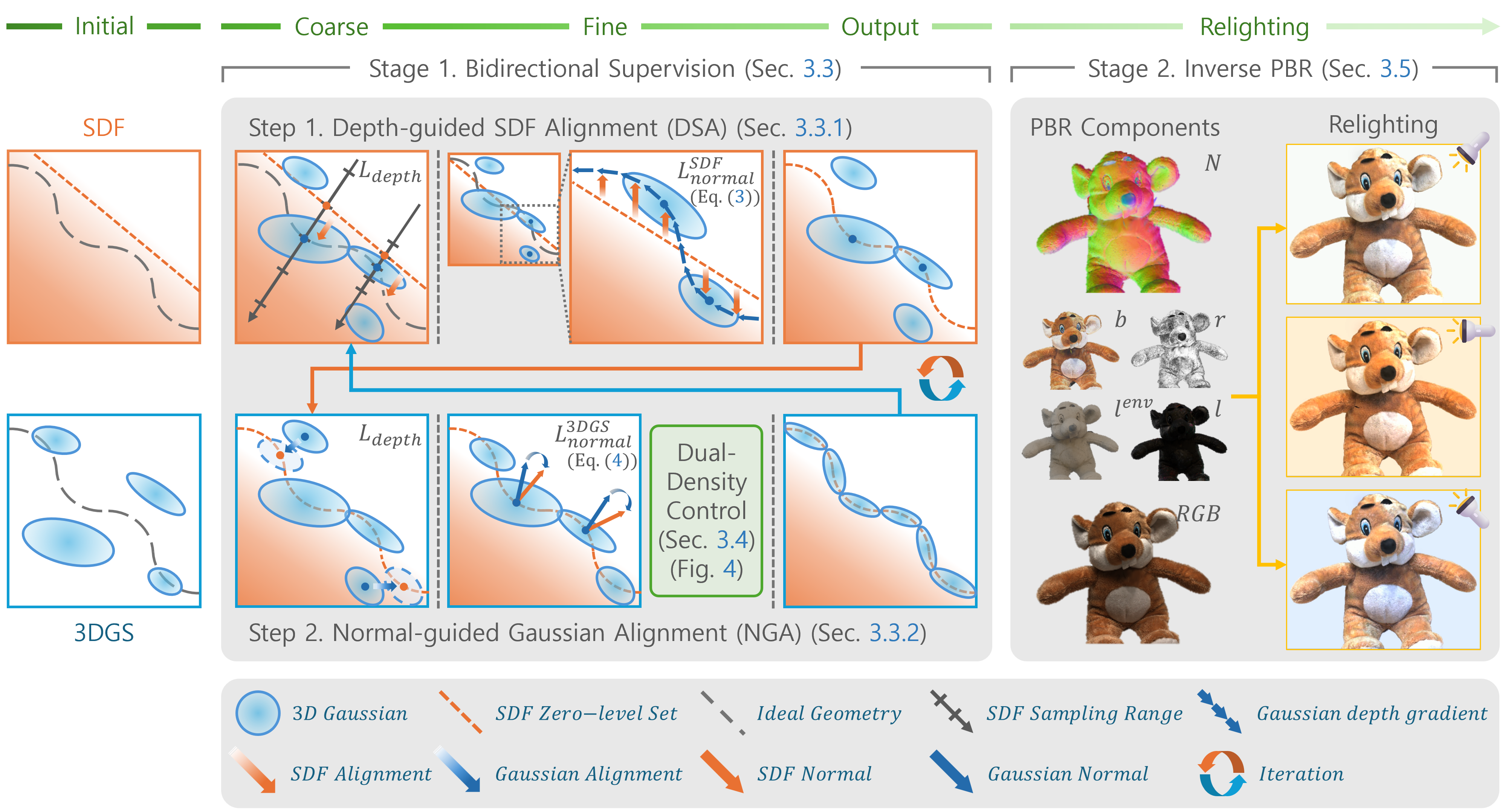
Our method jointly trains an SDF and relightable 3D Gaussians via geometric coupling on a shared underlying surface, combining reliable depth signals from geometry-constrained relightable 3DGS with the continuous SDF normal field. The coupling uses two omplementary modules: (i) DSA aligns the SDF to 3DGS via depth-guided ray sampling and matches SDF normals to pixel-wise depth gradients from the 3DGS depth map. (ii) NGA guides Gaussians toward the SDF depth surface via depth consistency and aligns Gaussian normals with the continuous SDF normal field, stabilizing normal learning for discrete Gaussians. DDC regulates normal-aware densification using photometric and geometric gradients to suppress redundant splitting. In the second stage, Inverse PBR optimizes BRDF and lighting on the learned geometry, enabling accurate BRDF-lighting decomposition and faithful relighting under novel illumination.
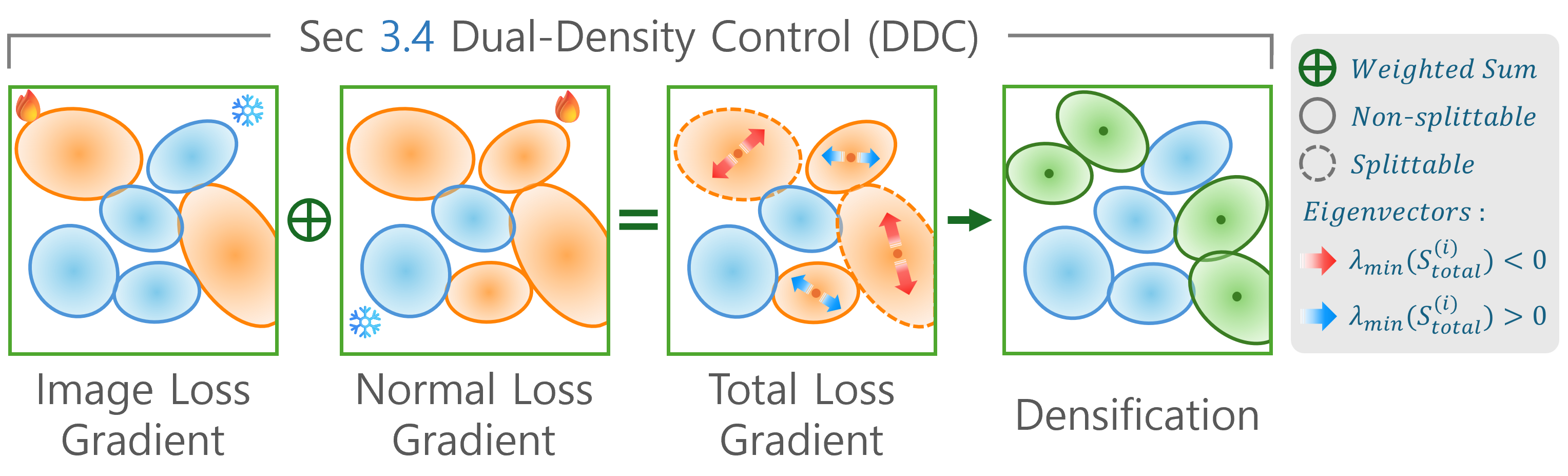
Gaussians whose accumulated gradients exceed the densification threshold are marked in red, while others remain blue. For candidates, DDC combines splitting matrices from photometric and geometric gradients into Stotal. A candidate is split into green Gaussians only if λmin(Stotal) < 0, indicating a descent direction that reduces the overall loss.
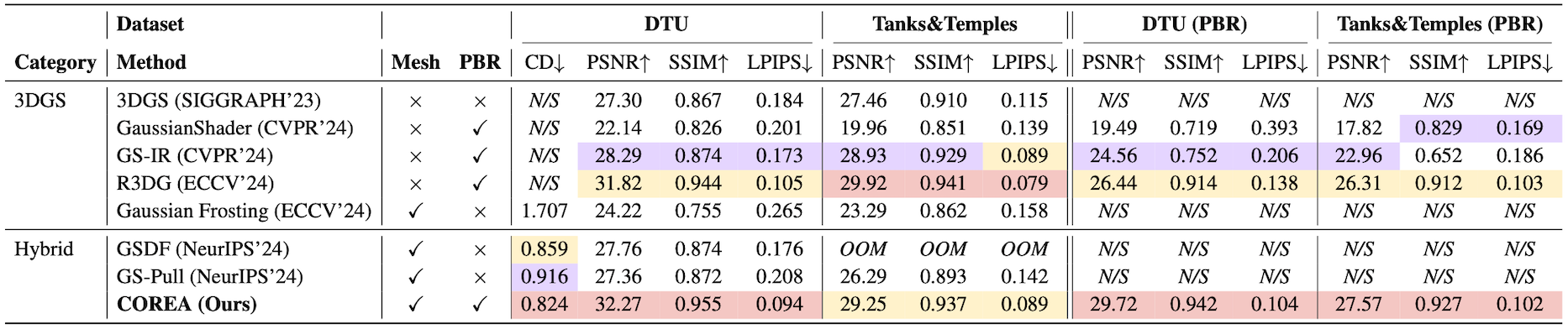
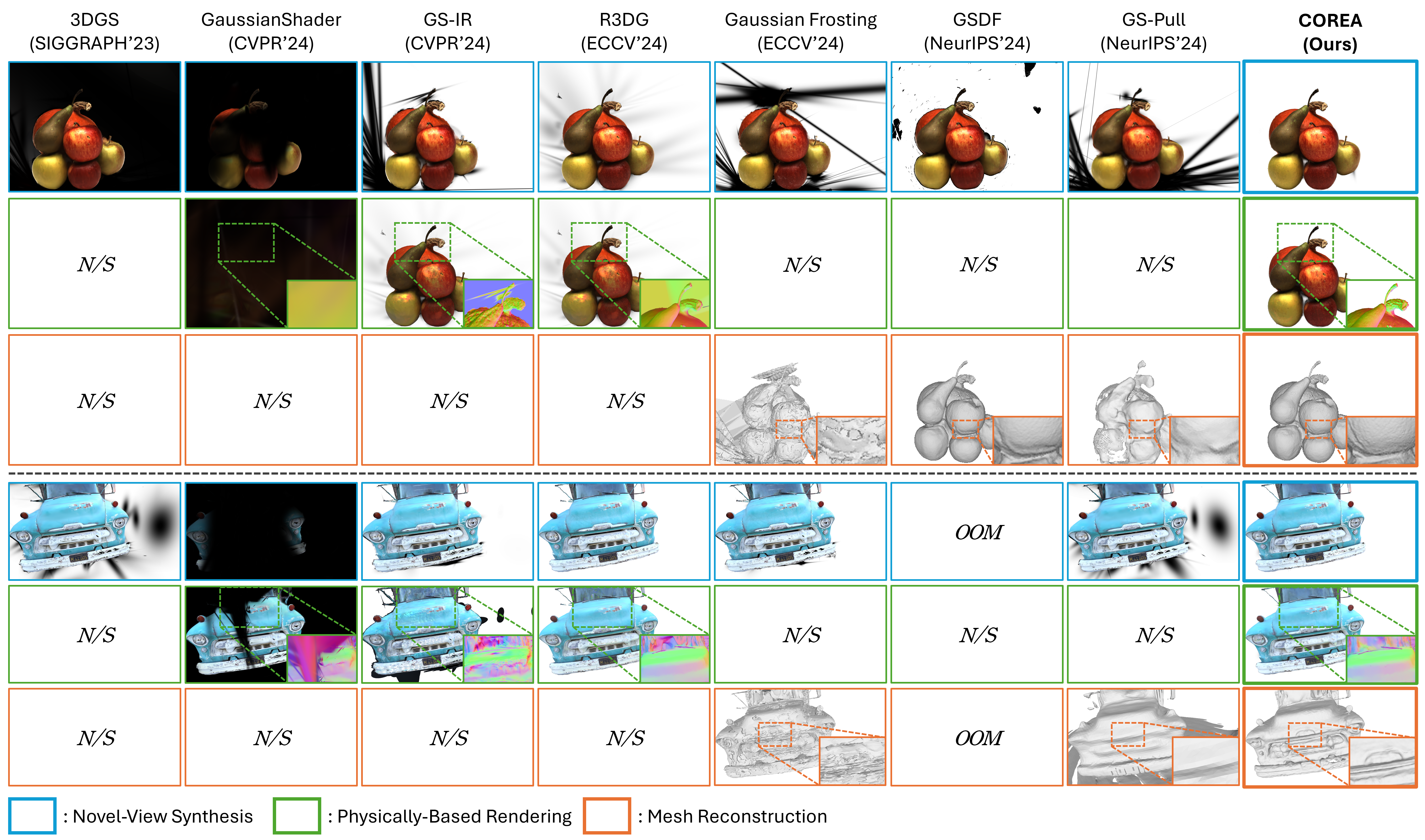
We compare COREA with recent Gaussian-based methods on three tasks: SH-based NVS, Surface Reconstruction, and Inverse PBR. All results are rendered on a white background for consistent visual comparison. Artifacts such as black background patches or dark speckles observed in some baselines stem from excessive Gaussian opacity; by contrast, COREA produces clean, artifact-free renderings on white backgrounds. Our method also provides results for all three tasks, whereas others show N/S (Not Supported) or OOM (Out of Memory) in several cases. Overall, COREA yields sharper novel views, finer geometric details through coarse-to-fine bidirectional 3D-to-3D supervision, and more faithful Inverse PBR.
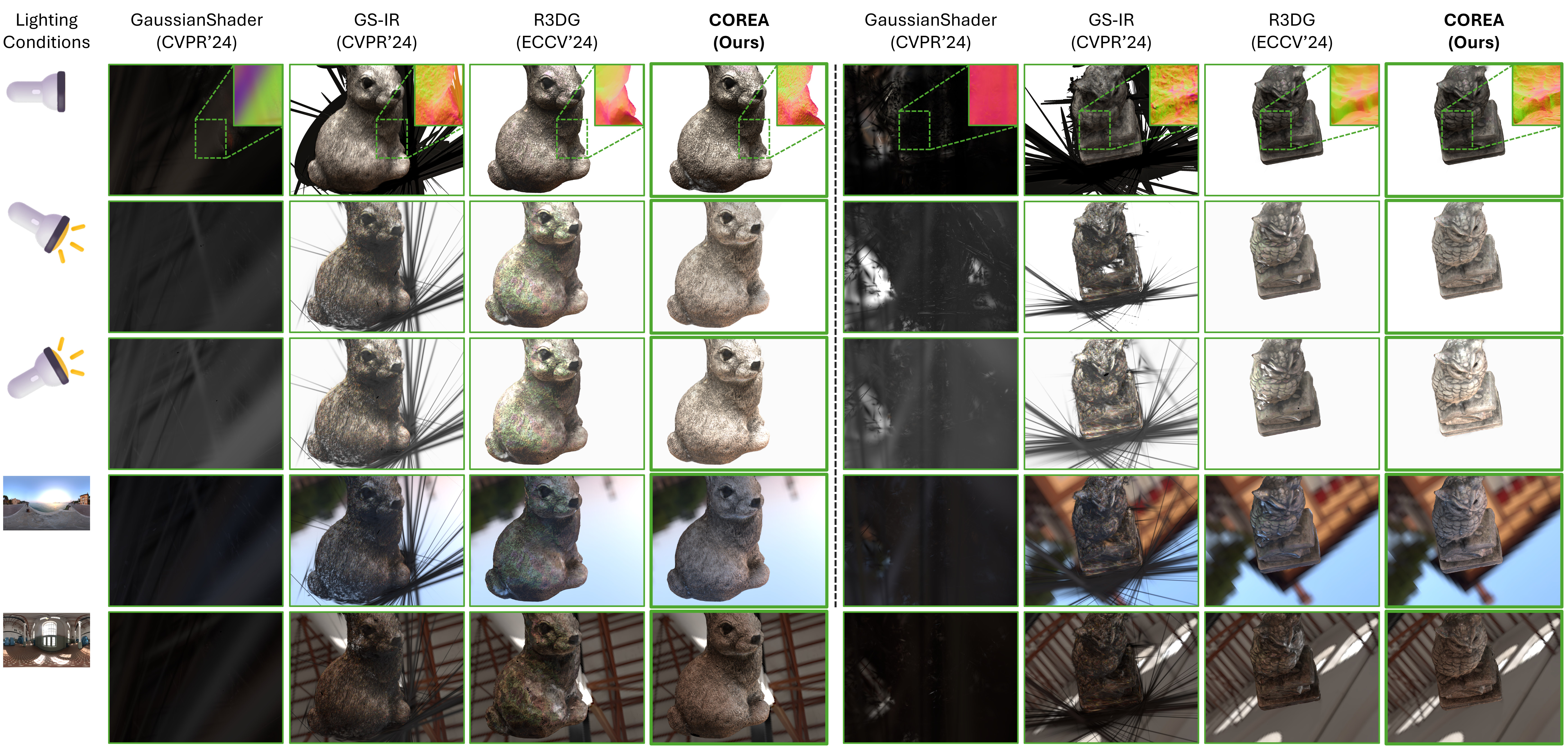
We compare COREA with recent relightable Gaussian-based methods under varying illumination conditions. The first row shows Inverse PBR renderings under the original lighting setup, while the remaining rows illustrate relighting results under directional lights and various HDR environment maps. Compared to previous methods that exhibit black background artifacts or unstable reflectance under varying illumination, COREA maintains consistent shading, clean appearance, and accurate reflectance reconstruction across all lighting conditions, demonstrating robust BRDF and geometry alignment.
Demos for SH-based NVS, Surface Reconstruction, and Inverse PBR. (Click a thumbnail to switch)
@inproceedings{lee2025corea,
  title     = {COREA: Coupled Relightable 3D Gaussians and SDFs for Efficient Normal Alignment},
  author    = {Jaeyoon Lee and Hojoon Jung and Sungtae Hwang and Jihyong Oh and Jongwon Choi},
  booktitle = {arXiv preprint arXiv:2512.07107},
  year      = {2026}
}